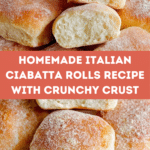
Italian Ciabatta Recipe
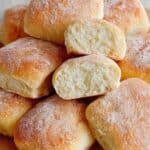
This authentic Italian Ciabatta recipe yields soft, airy, and delightfully crusty bread rolls, made using a traditional BIGA starter and semolina flour. Perfectly suited for sandwiches or as a side to any Italian meal, these rolls boast a tender crumb and a crisp, golden crust achieved through careful fermentation and baking.
- Prep Time: 20 minutes (plus 12-16 hours BIGA fermentation and additional proofing)
- Cook Time: 25-30 minutes
- Total Time: Approximately 14-16 hours including fermentation and proofing
- Yield: About 20-24 ciabatta rolls (2.5 x 2.5 inch each) 1x
- Category: Bread
- Method: Baking
- Cuisine: Italian
Ingredients
Scale
BIGA Starter
- 8 1/2 cups bread flour
- 3 teaspoons active dry yeast
- 2 1/4 cups water (70°F or 21°C)
Ciabatta Dough
- 3 cups semolina flour (plus more for dusting)
- 2 teaspoons active dry yeast
- 2 cups plus 1 tablespoon water (70°F or 21°C)
- 2 tablespoons granulated sugar
- 5 tablespoons extra virgin olive oil
- 6 teaspoons fine sea salt
Instructions
- Prepare BIGA Starter: In a stand mixer fitted with a dough hook, combine bread flour and yeast on medium low speed. Gradually add 2 1/4 cups water while mixing until a shaggy dough forms. Increase mixer speed to high and mix for 1-2 minutes until dough forms a solid mass.
- First Rise: Transfer the dough to a large bowl, cover with a tea towel, and let it rise at room temperature for 12-16 hours, until the surface is crusty and flat indicating optimal fermentation.
- Prepare BIGA for Ciabatta: Once ready, discard a thin crusty layer from the BIGA top and measure out about 5 cups (1200 grams) of the starter to use immediately.
- Mix Ciabatta Dough: In the mixer, combine semolina flour and yeast on medium low speed. Slowly add 2 cups plus 1 tablespoon water, scraping down bowl sides as needed. Mix in the 5 cups (1200 grams) of prepared BIGA until incorporated, then add granulated sugar and mix until combined.
- Add Oil and Salt: Add the extra virgin olive oil into the center of the dough and mix. Then add fine sea salt and increase mixer speed to high. Continue mixing until a popping sound is heard and dough wraps around the hook. The dough should be smooth yet very sticky.
- First Proof: Prepare a 9 x 13 inch metal pan with a generous dusting of semolina flour. Place the dough in the pan, dust top and sides with semolina flour, cover with plastic wrap, and let rise in a warm, draft-free place until doubled and dough fills the pan. Timing varies with temperature.
- Shape Rolls: Generously flour a clean work surface with semolina flour. Gently flip the dough out and cut into 2.5 x 2.5 inch (6 x 6 cm) rolls using a bench scraper or sharp knife, taking care not to deflate the dough.
- Second Proof: Transfer rolls carefully onto parchment-lined light colored baking sheets spaced 1-2 inches apart. Dust tops generously with semolina flour, cover lightly with plastic wrap, and proof in a warm (75°F – 80°F or 24°C – 27°C) draft-free place until doubled in size, about 60 minutes.
- Preheat Oven: Heat oven to 400°F (205°C) while the dough proofs.
- Bake: Bake the rolls for 25-30 minutes, rotating the baking sheets halfway through, until they develop a light golden crust.
- Cool: Transfer the ciabatta to a cooling rack and cover with a tea towel. Allow the rolls to cool to room temperature before slicing or serving.
Notes
- Use bread flour and semolina flour for optimal texture and flavor.
- The BIGA fermentation time is important for developing flavor and structure.
- Ensure water is at 70°F (21°C) for yeast activation without killing the yeast.
- Handle the dough gently during shaping to retain air for a light crumb.
- Dusting with semolina flour prevents sticking and adds texture to the crust.
- Use light colored baking sheets to avoid over-browning the crust.
- Allow rolls to cool completely to finish the baking process internally.
Keywords: Italian ciabatta, ciabatta rolls, homemade bread, BIGA starter, semolina bread, crusty bread rolls
Find it online: https://heutigemahlzeiten.com/italian-ciabatta-recipe/